
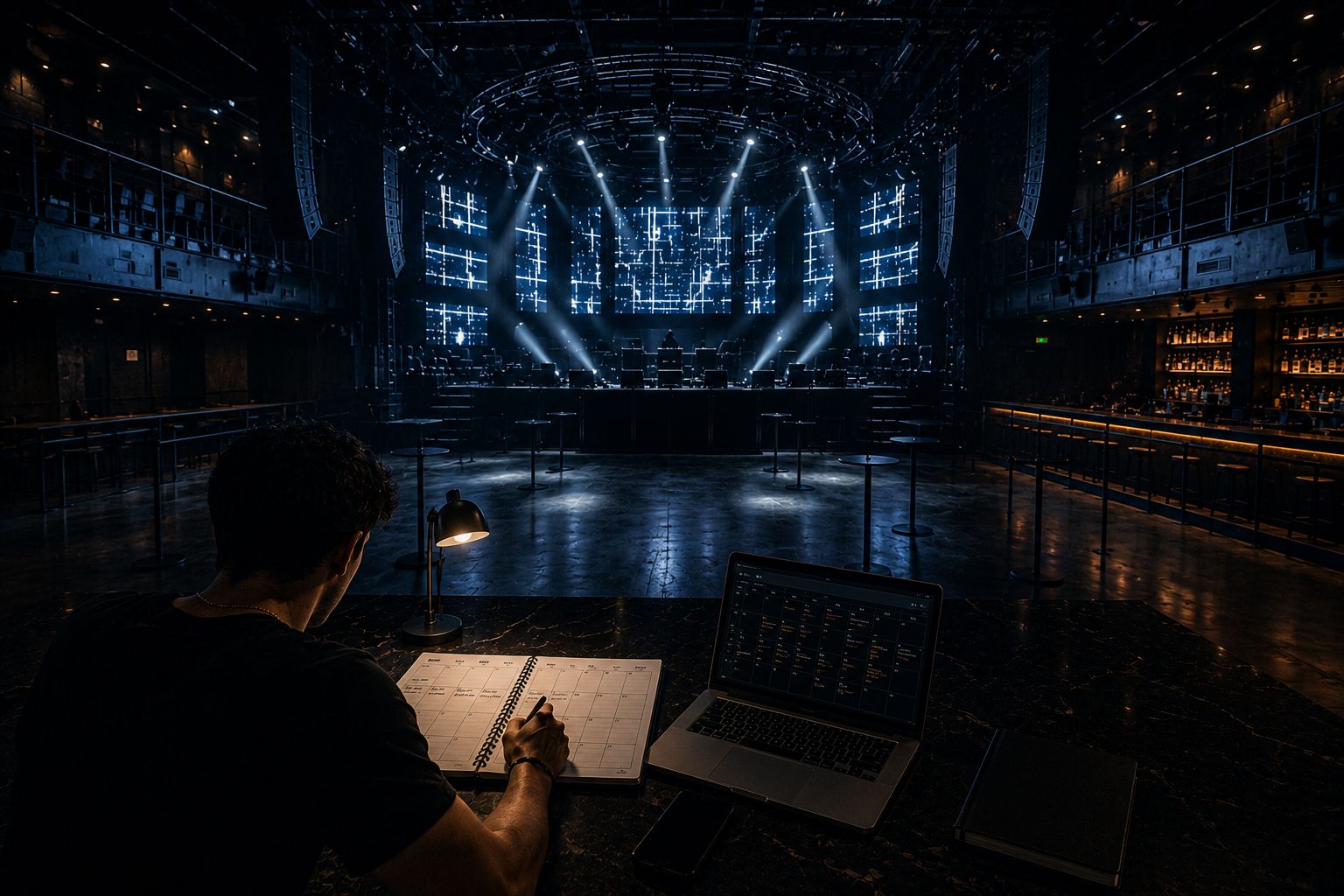
Programming can amplify nightlife venues. But when programming becomes the primary reason guests return, the business becomes structurally unstable.
Some nightlife venues aren’t operating brands. They’re operating calendars.
Every week depends on another DJ, another promoter, another activation, another themed event, another spike large enough to keep momentum alive for a few more nights.
From the outside, this often looks like success. The room remains active, the marketing stays loud, and the venue appears culturally relevant. But underneath the stimulation, many operators are quietly building one of the weakest business models in nightlife: a venue incapable of generating demand without constant intervention.
That’s not momentum, that’s dependency.
AI-generated image
Programming has always been part of nightlife. It creates excitement, novelty, urgency, and discovery. Strong programming can absolutely introduce new guests to a venue, increase visibility, and create cultural energy inside a market.
This article isn’t an argument against programming. It’s an argument against programming becoming the primary retention engine of the business.
That distinction matters operationally, financially, and culturally.
Acquisition and retention aren’t the same thing.
Programming is often an excellent acquisition mechanism.
It can create attention, attract new guests, and generate social visibility. Programming can activate slower nights, refresh energy, and introduce new audiences to a venue.
But acquisition and retention aren’t interchangeable.
Many nightlife operators unknowingly build venues where:
- guests are loyal to events, not the venue
- the crowd belongs to promoters, not the brand
- identity changes nightly
- demand disappears without stimulation
- revenue requires constant artificial injection
- marketing spend becomes permanent life support
That’s structural weakness. Once the stimulation slows, the venue itself has very little gravitational pull remaining.
Escalation eventually becomes mandatory.
Programming dependency creates a dangerous operational cycle. Once a venue conditions its audience to expect constant stimulation, baseline demand often weakens. Normal nights begin feeling “slow” even when traffic remains commercially healthy.
Operators start escalating to maintain emotional momentum: bigger talent, larger productions, more aggressive promotions, more frequent activations, higher marketing spend, and increasingly compressed turnaround cycles. Now the venue must continuously outperform its previous version of itself simply to maintain baseline relevance.
That’s not growth. That’s survival pressure disguised as momentum. And over time, escalation becomes exhausting financially, operationally, culturally, and psychologically.
Identity instability weakens long-term gravity.
One of the biggest hidden consequences of programming dependency is identity fragmentation. When the venue constantly changes personalities to fit different events, consistency begins to erode: the crowd, the tone, the atmosphere, and the expectations all change.
Eventually, guests stop understanding what the venue actually is. This is where many nightlife operators unknowingly begin outsourcing brand identity to external stimulation.
Promoters become stronger brands than the venue itself. Events become more recognizable than the operating philosophy. The calendar becomes more important than the culture. The venue may still generate traffic, but traffic alone does not create attachment.
And attachment is what creates retention.
Strong nightlife venues still matter when nothing special is happening.
The healthiest nightlife venues generate demand even during ordinary nights. Not because the room is empty without programming or because programming is ineffective, but because the venue itself has become socially meaningful.
Guests return because:
- they trust the experience
- they recognize the atmosphere
- they identify with the crowd
- they understand the energy
- they feel familiarity
- they feel belonging
That’s an entirely different level of operational strength. Programming can amplify those environments significantly but amplification only works sustainably when something stable already exists underneath it. Otherwise, the business becomes dependent on permanent stimulation to survive.
Structural strength creates operational freedom.
The strongest nightlife venues don’t panic every time traffic softens temporarily. They understand that every night doesn’t need to peak because consistency, familiarity, retention, and identity compound. Most importantly, they understand that quieter consistency is often economically healthier than unstable volatility.
Because operationally, stable demand creates:
- better forecasting
- healthier staffing
- stronger margins
- lower marketing pressure
- better guest familiarity
- stronger culture
- lower emotional volatility inside the business
That stability creates freedom. Dependency destroys it.
Programming should amplify gravity, not replace it.
Strong programming absolutely matters in nightlife. But the venue itself must still remain the primary attraction layer.
That means:
- the atmosphere matters
- the standards matter
- the identity matters
- the consistency matters
- the emotional experience matters
- the social environment matters
In the long run, nightlife venues don’t survive on stimulation alone; they survive on behavioral return patterns. And behavioral return patterns are built through gravity, not noise.
Everything else is expensive.
If this sounds familiar:
If your venue depends on constant promotions, headliners, or weekly programming just to maintain momentum, the challenge may be structural rather than promotional. The Nightlife Operator Intensive™ is designed to uncover the operational, leadership, and strategic gaps that programming alone can’t solve. We help you identify where long-term performance is being built or quietly lost.