
Hospitality attracts ambitious personalities. That’s both one of the industry’s greatest strengths and one of its most dangerous vulnerabilities.
There’s nothing wrong with wanting to build something exciting. Hospitality has always attracted visionaries, creatives, connectors, tastemakers, performers, entrepreneurs, and highly social personalities. In many ways, the industry depends on people capable of imagining experiences emotionally before they ever exist physically.
But hospitality also has a dangerous tendency to romanticize visibility while underestimating operational reality.
That imbalance destroys more concepts than most people realize. Some founders build concepts they want to be seen in. Others build concepts they are actually equipped to sustain.
Those aren’t always the same thing.
AI-generated image
Because hospitality is such an emotionally expressive industry, founders often confuse:
- admiration with capability
- aesthetics with infrastructure
- social validation with strategic alignment
- attention with durability
- “cool” with operational viability
The consequences can become expensive very quickly. Hospitality isn’t protected by aesthetics alone, it’s protected by operational maturity.
And operational maturity is learnable.
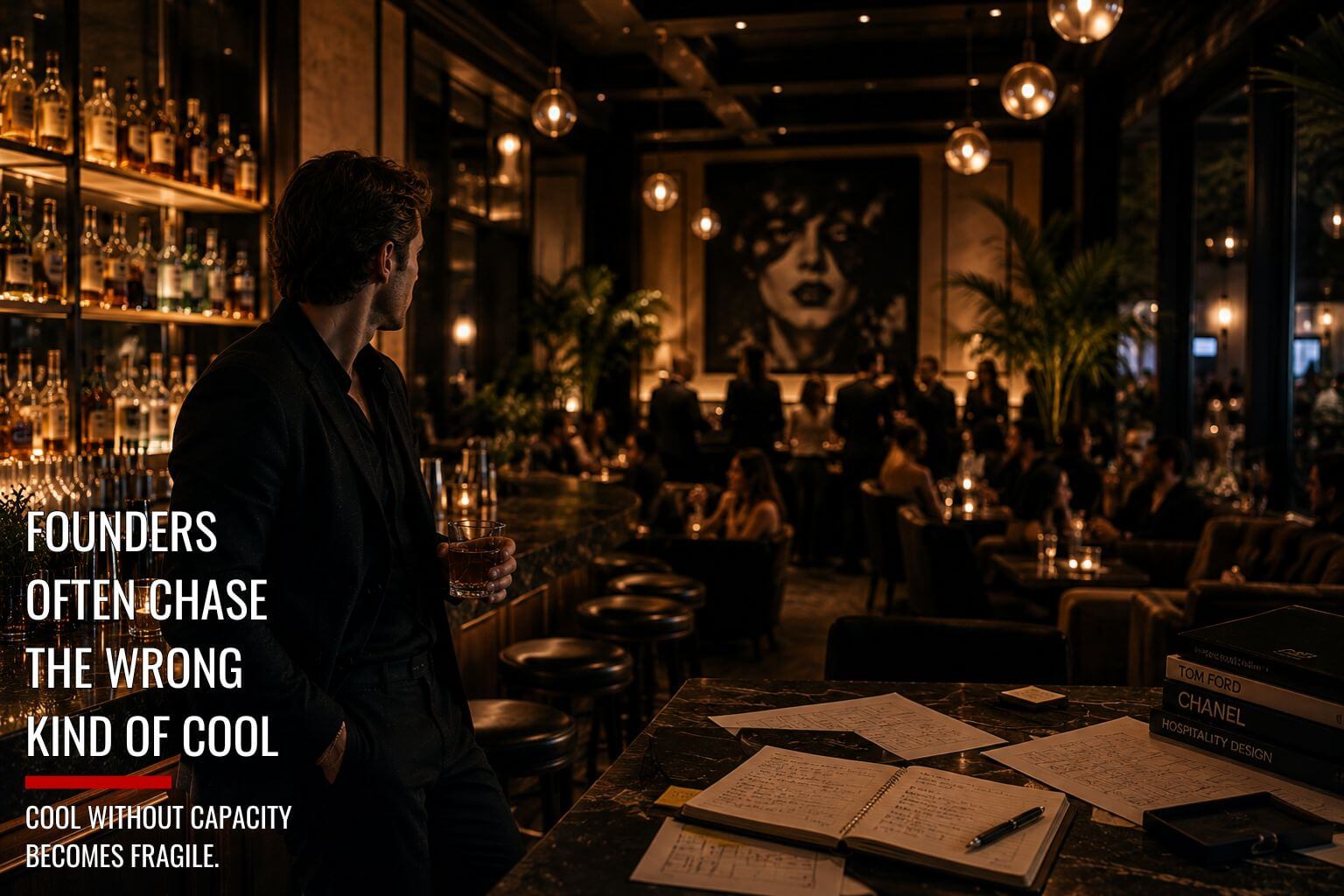
Founders Often Chase the Wrong Kind of Cool
A significant number of concepts are designed around identity projection rather than operational alignment. The founder wants the recognition, social positioning, and cultural relevance of the room they’ve designed. They want to be known for that space’s energy, and they crave what they think is the lifestyle associated with ownership.
However, wanting to be associated with a hospitality concept isn’t the same thing as being capable of operating one successfully. That difference becomes painfully visible under pressure.
Particularly in nightlife, operators often chase concepts that look exciting externally while underestimating staffing complexity, leadership pressure, emotional regulation, financial discipline, systems management and the consistency they require, conflict resolution, and operational exhaustion.
Hospitality can look glamorous from the guest side of the room. But the operator side? That looks very different.
Projection
Some concepts are less about guests and more about founder self-image expressed physically. The venue becomes a reflection of how the founder wants to be perceived: important, influential, sophisticated, culturally connected, and, increasingly, “disruptive.”
The problem is that identity projection rarely creates operational stability on its own. Guests may initially respond to confidence, aesthetics, or novelty, but long-term hospitality success depends on something much more difficult. For an operator be at the helm of a single stable location (not wildly successful, just stable), they must understand and focus on leadership, accountability (for themselves, not just their team), standards, consistency, systems discipline, and emotional steadiness.
Projection can attract attention. It can’t protect a concept from operational drift.
Identity Confusion
Some founders build concepts fundamentally misaligned with their actual temperament. That creates instability quickly.
A few examples:
- Highly introverted founders attempting intensely social nightlife concepts
- Emotionally reactive founders attempting luxury hospitality
- Highly creative founders resisting operational structure
- Disorganized founders building operationally complex programs
- Socially-driven founders underestimating administrative responsibility
I really can’t stress this enough: hospitality amplifies personality patterns under pressure. The wrong concept paired with the wrong leadership temperament often creates cultural inconsistency, leadership volatility, staff confusion, operational chaos, and unpredictable guest traffic and behavior patterns.
Strong hospitality concepts require alignment between identity, leadership style, operational capacity, systems tolerance, and emotional endurance. Without that alignment, “cool” becomes fragile very quickly.
Aspirational Ego
Hospitality is full of aspirational admiration. And that isn’t an inherent negative, certainly. Operators find inspiration in legendary bars, iconic hotels, celebrated nightlife venues, and culturally significant hospitality groups. But admiration can quietly become dangerous when founders begin confusing inspiration with capability.
Admiring a hospitality brand doesn’t automatically mean said admirer is equipped to operate one. Some founders love the idea of high-touch luxury service while lacking the patience required to maintain standards consistently. Others love high-energy nightlife environments while lacking the emotional regulation required to lead teams through pressure repeatedly. Still others love the image of hospitality leadership while resisting the discipline hospitality leadership demands.
The operational implications become enormous over time, because hospitality eventually exposes the difference between performance and endurance.
Operator Misalignment
Some people should absolutely own hospitality concepts. That doesn’t, however, automatically mean they should operate them directly. This is an important distinction many founders resist emotionally.
Hospitality contains all manner of successful personalities: creatives, marketers, connectors, public-facing personalities, entertainers, investors, community builders, and tastemakers. And these people can become incredibly valuable founders. That said, operational leadership is its own discipline entirely.
Strong operators stabilize systems, standards, and staffing. They understand the importance of leading with accountability, consistency, clear communication, and execution under pressure. As important, they don’t just understand it, they live it.
Wanting ownership and being equipped to manage operational complexity aren’t identical skill sets, and realizing this truth isn’t weakness. This is maturity, and it’s real strength.
Lifestyle Fantasy
Hospitality is frequently romanticized by people who have never carried its operational weight. This is particularly true of nightlife. From the outside, nightlife often appears to be a world of status, recognition, exclusivity, social access, influence, and excitement.
Well, let’s stop the high-definition, slow-motion image of a well-dressed operator striding confidently through their incredible, sexy, packed nightclub. That’s a movie; I’m here to discuss reality.
And that reality consists of payroll pressure, staffing shortages, leadership strain, guest complaints, inventory control, licensing compliance, maintenance failures, financial unpredictability, and emotional fatigue. This is where many founders encounter reality for the first time, the lifestyle fantasy colliding with operational responsibility.
Responsibility is far less glamorous than visibility. I don’t care how slowly you play the scene of an operator with their head in their hands as they sift through metrics and P&Ls on their fourth day of very little sleep, that’s not sexy.
The operators who endure eventually stop chasing image and start protecting systems. That’s the beginning of stewardship.
Status Chasing
Status-chasing concepts often reveal themselves quickly. They over-spend on aesthetics, over-design environments, over-promise experiences, chase exclusivity theatrically, mimic trends aggressively, and prioritize visibility over infrastructure. In many cases, operators want the identity of hospitality success before building the operational foundation capable of supporting it. That creates fragile concepts; “cool” unsupported by systems eventually collapses under pressure.
The strongest hospitality brands aren’t built through image alone. They’re built through operational discipline, behavioral consistency, leadership maturity, strategic clarity and restraint, systems awareness, and stewardship. These brands have clarity around their identity, but they understand that’s just one element of the business. That clarity is difficult to fake.
Not Every Founder Should Run Operations
This may be one of the most important realizations in hospitality: not every founder needs to become the operator.
Some founders are extraordinary when it comes to vision, building relationships, community presence, cultural positioning, marketing, fundraising, and concept creation. That’s valuable. But successful hospitality ecosystems often emerge when founders recognize where operational leadership becomes necessary, and they intentionally empower people capable of stabilizing the business structurally. Hospitality rewards self-awareness far more consistently than ego.
The strongest founders are rarely the the people pretending to know everything. More often, they’re the people intentional enough to seek mentors, leadership development, experienced operators, strategic guidance, and operational accountability before preventable problems become structural failures.
Operational maturity isn’t reserved for people born systems-oriented. It can be learned intentionally, and founders who begin by chasing “cool” can eventually become exceptional hospitality leaders once they embrace structure, mentorship, operational discipline, and stewardship seriously.
Self-Awareness Is a Competitive Advantage
Self-awareness may be one of the most underrated advantages in hospitality. It may take a while, but this business eventually exposes ego, inconsistency, emotional volatility, lack of structure, leadership weakness, and operational avoidance. Simply put, hospitality is too operationally demanding to sustain illusion indefinitely.
Founders who understand themselves clearly tend to make better decisions. They pursue and enter into better partnerships. They make better hiring decisions, and build better operational structures. They leverage better strategic pacing, and they put their focus on better concept alignment. And, importantly, they tend to build concepts capable of surviving pressure instead of merely attracting attention.
The strongest hospitality concepts are rarely built from fantasy alone. They’re built from alignment between identity, operational capacity, leadership structure, systems discipline, standards, and stewardship.
Founders who chase attention often build fragile brands. Founders who understand themselves build brands capable of gravity.
Move beyond assumptions.
Cool may attract attention, but it doesn’t create a resilient business. The Nightlife Operator Intensive™ helps founders move beyond assumptions by evaluating the operational systems, strategic decisions, and leadership habits that determine whether attention becomes sustainable performance.